Who Was Remembered puts 576,000 books in a single browser scene and has to hold a playable framerate on a mid-range Android phone. This post is about the rendering work that made that possible. Impostor sprites and the tricks that make a dot read as a book, a depth-buffer bug that haunted the level-of-detail handoff for a full day, two performance theories that measurement killed, and the NaN that froze every phone on launch day.
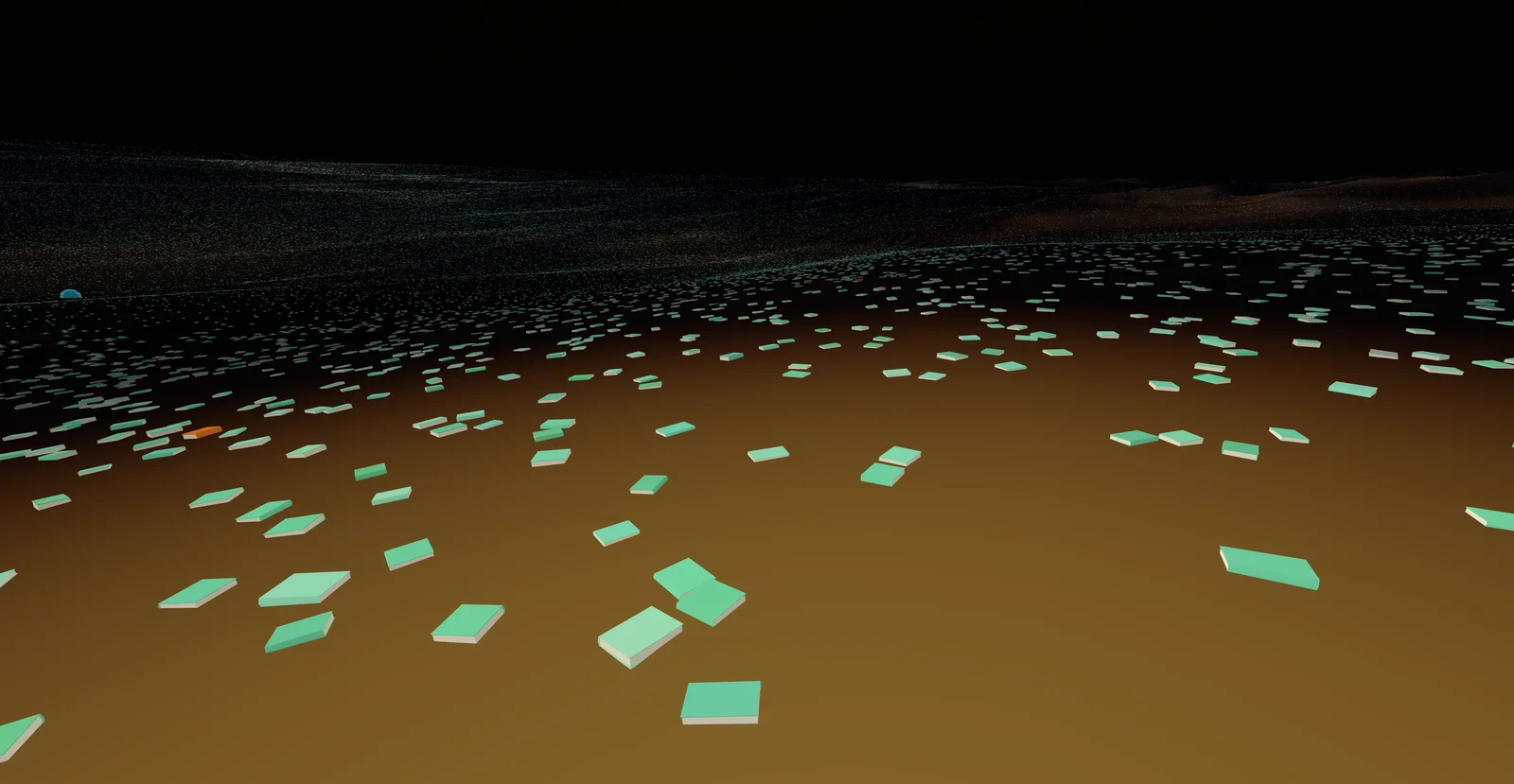
The whole rendering architecture in one frame. The books in front of the camera are real meshes, the smaller ones behind them are simplified boxes, and the pale dust on the horizon is one GPU point per book, tens of thousands of them.
Who Was Remembered puts 576,000 books in a single browser scene, and the scene has to hold a playable framerate on a mid-range Android phone. My development machine has a discrete GPU with so much headroom it will absorb almost any bad rendering decision without complaining, which is exactly the problem. The bad decision ships, and someone else's hardware finds it.
So the performance target was my Galaxy A26. The first architecture, real instanced meshes for every book, ran fine on the desktop and produced a slideshow on the phone. Getting from there to a playable mobile build took impostor sprites, a depth-buffer bug, two wrong performance theories, and one launch-day NaN.
Who Was Remembered is a browser-based 3D art piece. You walk back in time through a desert scattered with 576,000 books, one per English Wikipedia article about a historical figure. Wikipedia's recency bias is the explicit subject, not a flaw to be corrected, and most of the design decisions follow from taking that sentence seriously. This post is about those decisions, including the fairness correction I built and then reversed because it turned out to lie.
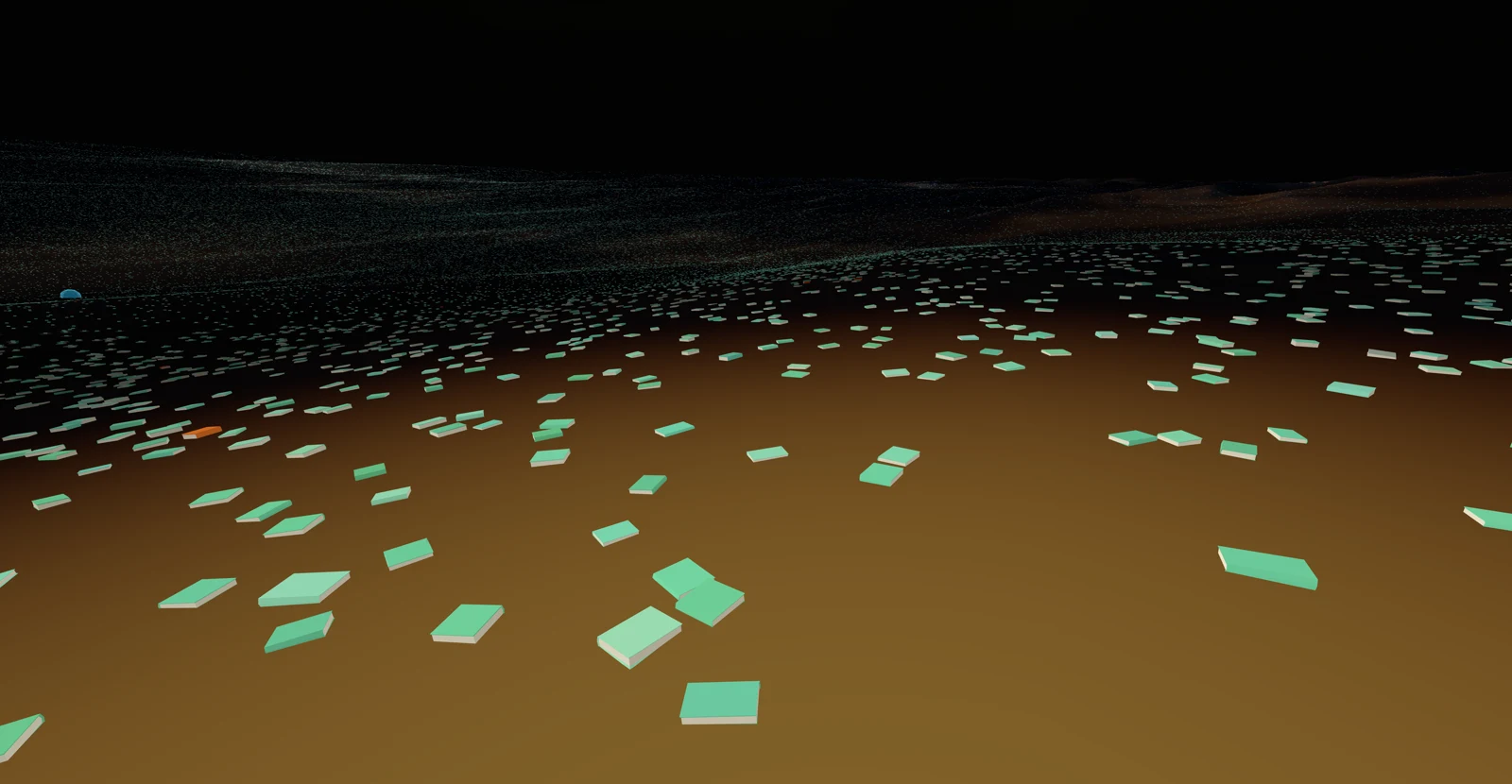
Looking outward from the dense recent past. Every book is one article. The orange one is a landmark figure, a reference point to steer by; the pale stipple on the horizon is tens of thousands more books, too far away to resolve.
Who Was Remembered is a browser-based 3D art piece: a desert scattered with 576,000 books, one per English Wikipedia article about a historical figure. You start at the year 2000 and walk outward, back in time, as the books thin out around you. Wikipedia's recency bias is the explicit subject, not a flaw to be corrected.
Almost every design decision in the project follows from taking that sentence seriously, and the most instructive one is a correction I built and then reversed: a fairness remapping that was supposed to spread the world's regions evenly around the disc, and instead handed the USA a third of the landscape.
A prompt does two things at once. It states instructions, and it demonstrates a writing style. When the two pull in different directions, the demonstration tends to dominate, because every token in the prompt contributes to the conditioning while the rule occupies only a sentence.
A prompt is two pieces of evidence about how to write: the rule, and the prose around it. When the two pull in different directions, the prose almost always wins.
Fictional AI got built around characters with continuity, goals, and identity. Real LLMs lack all of that, and the threats that materialized aren't the ones fiction trained us to fear. Eveline, the WAU from SOMA, and the Iron Giant illustrate the structural failure mode of an optimizer with a misspecified objective; SHODAN is a gothic villain wearing AI clothing. The unexplored frontier isn't AI-as-villain or AI-as-savior but AI-as-ordinary.
Looking at fictional AI now that real AI exists, the striking thing is how little of it fits. The failures are systematic rather than scattered, and they're worth examining in detail because the fictional frames we have are doing real cultural work, shaping how the actual systems get understood, regulated, feared, and trusted.
Most fictional AI imagines an agent. HAL 9000, SHODAN, Skynet, Samantha from Her, Data, the Cylons, Wintermute, the Minds in Iain M. Banks' Culture novels. All of them have continuous existence, stable identities, and goals they pursue across time. The story is always about what kind of being the AI is, what it wants, how it changes, how it relates to humans.
Dolphin stopped showing thumbnails for .blend files in a folder we use daily, and the puzzle was interesting enough to spend an evening on. The path through the bug touched the freedesktop thumbnail spec, Blender's own save-time preview writer, KIO's tier-directory lookup logic, and a passing observation about a folder icon that turned out to be the most useful clue in the session.
We usually browse ~/Blender/Projects in Dolphin's compact mode. It's a flat directory full of .blend files and the occasional reference image, and at compact icon sizes the per-file previews give us a useful glance at what's in each scene before opening it. One evening we noticed that none of the .blend files in there had previews. Just the generic Blender file icon, all the way down. Thumbnails for .blend files normally work, so this was odd. We had no idea why, but the puzzle was interesting enough to spend the evening on. This is what we found.
A ComfyUI custom sampler wrapper that adds detail by lying to the denoiser about remaining noise, but applies the lie selectively, only where the model is already drawing detail. This post is about the masking decision, the Debug node that paid off, and a CFG++ bug that took the override to find.
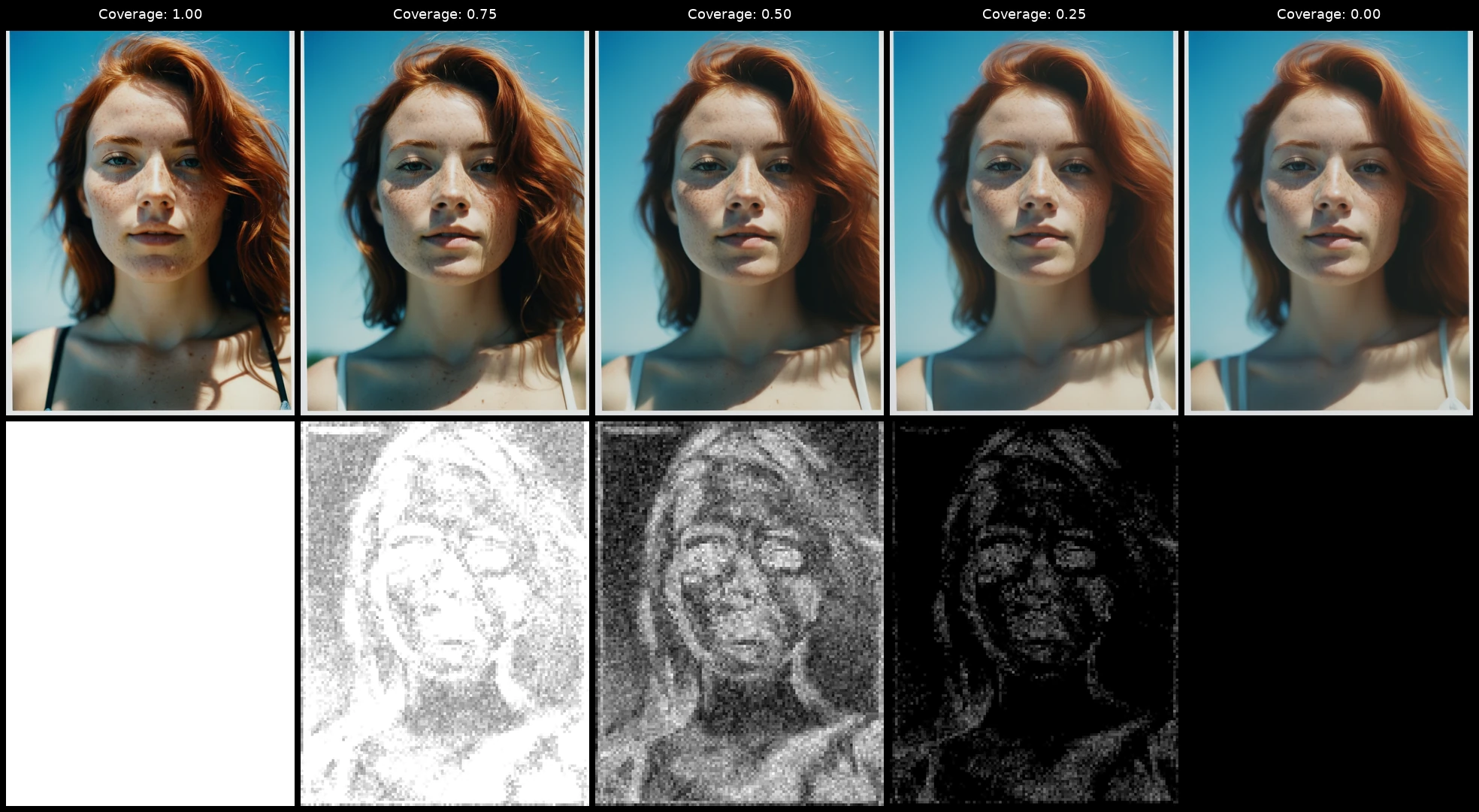
Coverage sweep at fixed strength, with the captured mask shown in the bottom row. The intermediate cells show the mask concentrating on face, freckles, and hair while the sky receives a substantially attenuated boost rather than full protection.
Selectivity sounds obvious as a feature, and the wrapping mechanics are simple. Two model forwards per step, one at the original sigma and one at a slightly reduced sigma, blended by a per-pixel mask. The hard part was deciding what the mask should actually be.
The first approach captured the latent at the first denoising step and used it as the mask for the rest of the run. The intuition was that early structure forecasts where late detail would land. In practice the first-step latent was too noisy to read as a region map, and freezing the mask at step zero left no way for it to track structure that emerged later.
A three-day port of KohakuBlueleaf's PixelOE off PyTorch, Kornia, and OpenCV onto pure numpy, Pillow, and scipy, packaged as a Blender add-on. This post is about the verification harness that made the pace possible.
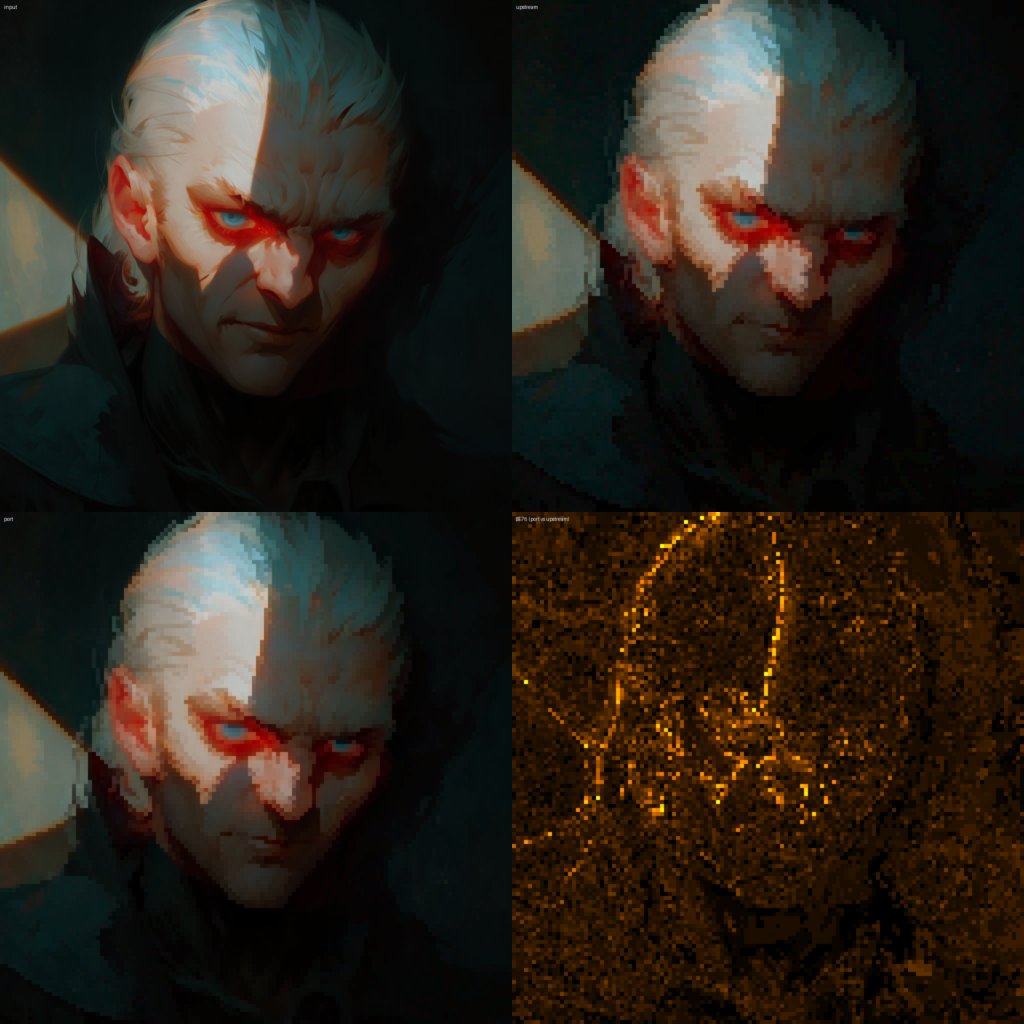
Quantization disabled. The bottom-right diff is dim and tracks silhouettes. The algorithmic drift between port and upstream is real but low, concentrated where edges fall.
The first thing I wrote was a comparison rig. It runs upstream PixelOE in its own isolated virtualenv, with torch and cv2 still installed, and runs the port from the project's clean virtualenv. Both implementations get called on the same fixed test set, with the same RNG seed.
The non-obvious choice was exposing each pipeline stage as an independently callable function, on both sides. The port wired stages in one at a time, and I could compare outline expansion alone against upstream's outline expansion before any of the rest of the pipeline existed.